Client Acquisition Checklist For Service Businesses

This client acquisition checklist for service businesses came out of a stretch in my own business when I thought busy meant successful.
I had clients. I had projects coming in. I had that satisfying feeling of a full calendar. And then, almost without warning, the calendar went quiet. Not slow. Quiet. I would look at my pipeline and feel that sinking realization that I had been so focused on serving the clients I had that I completely stopped bringing in the next ones.
In fact, I was not alone in that pattern. It is one of the most common struggles for service providers, and it has a name: the client acquisition rollercoaster. One month you are swamped. The next month you are wondering where everyone went.
The problem is not that you are bad at what you do. The problem is that lead generation was treated as something to do when things slowed down, rather than something that runs consistently, in the background, all the time.
That is when everything shifted for me.
I stopped thinking about client acquisition as a response to a slow season and started building it as a system. Not a complicated one. Not one that required me to be online every hour of every day. A repeatable, intentional process that keeps leads coming in whether I am actively marketing or deep in a client project.
This client acquisition checklist is what came out of that shift.
Why Consistent Leads Are Your Business’s Lifeblood
Inconsistent lead flow does not just affect your income. It affects everything.
When you do not know where your next client is coming from, you make decisions from scarcity. You take projects that are not a great fit. You discount your rates. You say yes when you should say no. You spend more energy worrying about the pipeline than you do doing the work you are actually good at.
There is also the cash flow reality. Service businesses live and die by the gap between when work is agreed upon and when revenue arrives. A few quiet months can put significant pressure on a business that is otherwise quite healthy. Team morale, if you have a team, takes a hit too. Nothing destabilizes a business faster than unpredictable revenue.
This is why the goal is not just more leads. The goal is consistent leads.
A steady, predictable flow of qualified prospects changes how you run your business. You negotiate from a place of confidence. You attract clients you actually want to work with. You can plan, hire, invest, and grow with some degree of certainty.
Consistency is the goal. This client acquisition checklist is how you build it.


Your 5-Step Client Acquisition Consistency Checklist
This is not a list of tactics to try and abandon. It is a framework for auditing your entire client acquisition system, identifying the gaps, and building something that actually holds.
Work through this client acquisition checklist as an honest assessment of where you are right now, not where you want to be.
Step 1: Solidify Your Foundation
Everything else in this client acquisition checklist depends on this step being done well. If your foundation is shaky, no amount of outreach or content will produce consistent results.
Define Your Ideal Client
I quickly learned that “I work with small businesses” is not a client description. It is a category. And when you market to a category, you connect with no one.
Your ideal client has a specific problem. They are at a specific stage of their business. They feel a specific frustration. They are spending their time in specific places online. The more precisely you can describe that person, the more directly your marketing will speak to them.
Before you do anything else, write out who this person actually is. What keeps them up at night? What have they already tried? What outcome are they hoping for? Where are they looking for answers?
When you know that, your messaging stops being generic. It starts landing.
Craft Your Irresistible Offer and Messaging
Once you know who you are speaking to, you need to be able to say, clearly and quickly, what you do and why it matters to them.
Your unique value proposition is not a list of your services. It is the specific result your ideal client gets from working with you, stated in language they would actually use.
Test your messaging this way: if you described your offer to your ideal client and they said “that is exactly what I need,” you have it right. If they look uncertain or ask clarifying questions, you have more work to do.
Step 2: Diversify Your Outreach Channels
One of the most common reasons service businesses experience the rollercoaster is because they rely on one source of leads. Referrals dry up. An algorithm changes. A platform loses traction. And suddenly the pipeline is empty.
Identify Your Top Three Lead Sources
You do not need to be everywhere. That is a fast track to burnout and mediocre presence on six platforms at once.
What you need is to identify the three channels where your ideal client is actively looking for help and commit to showing up there consistently.
For some businesses, that is a combination of search traffic from a blog, a weekly email, and a specific social platform. For others, it is podcast guesting, LinkedIn, and a referral partner program. The right channels depend entirely on where your ideal client spends their time and how they prefer to find solutions.
Research this deliberately. Ask past clients how they found you. Look at where your best leads have come from. Then build your outreach strategy around what already works, not what seems trendy.
Systematize Initial Contact and Engagement
Once you know your channels, create a repeatable process for showing up on them.
This is where most service providers get stuck. They post when inspired, reach out when they remember, and follow up inconsistently. The result is a strategy that works sometimes, which is the same as a strategy that does not work.
A system turns activity into results. What does weekly engagement look like on each platform? What does a first conversation look like when someone shows interest? Write it down. Make it repeatable. That is how outreach becomes consistent.
Step 3: Nurture with Value, Not Pressure
The biggest mistake I see service providers make in their marketing is skipping the nurture phase entirely. They go from “here I am” to “here is my offer” without building the trust that makes someone want to say yes.
Build an Engaged Audience
People buy from people they trust. And trust is built before the sale, not during it.
Consistent, valuable content, whether that is blog posts, a weekly email, videos, or any format that fits your business, does something that cold outreach cannot: it lets potential clients get to know your thinking, your approach, and your personality over time. By the time they reach out, they already believe in what you do.
This is why I built an evergreen content system using Pinterest and email. I wanted leads to come in without me having to personally initiate every conversation. Content does that work. It runs while I am serving clients, taking a day off, or planning my next quarter.
The question is not whether to create content. The question is what format works for your audience and what schedule you can actually maintain.
Implement a Simple Follow-Up Sequence
When someone shows interest, what happens next?
If the answer is “I follow up when I remember,” that is the gap in your system. Interested prospects go cold faster than you think. A simple, clear follow-up process, whether partially automated or manually managed, keeps you top of mind without requiring you to track everything in your head.
This does not have to be elaborate. A three-email welcome sequence for new subscribers, a standard follow-up message after a discovery call inquiry, and a check-in at the 30-day mark for warm leads who did not convert yet covers most of what you need.
Simple and consistent beats elaborate and inconsistent every time.
Step 4: Streamline Your Conversion Process
You can have a full pipeline and still not convert well if the process for moving someone from “interested” to “client” is unclear or uncomfortable.
Optimize Your Discovery Call Framework
The discovery call is where your marketing work either pays off or falls apart. And most service providers approach it without a clear structure.
A good discovery call is not a pitch. It is a conversation where you help the potential client see their problem clearly, understand what is possible, and make a confident decision about whether working together makes sense.
That structure might look like this: open with what brought them to you, explore the specific challenge they are facing, clarify what they have already tried, paint a picture of what success looks like, and then present your solution in the context of all of that.
When you follow a clear framework, you qualify better, you close more confidently, and the clients who do say yes are a much better fit.
Create Clear Proposals and Contracts
Once someone is ready to move forward, the process for making it official should be smooth and professional.
Vague pricing, unclear deliverables, and a confusing onboarding process create doubt at exactly the wrong moment. A clear proposal with transparent pricing, specific outcomes, and a simple next step removes friction.
This is also where the professionalism of your process sends a message. A clean, organized closing process tells a client what working with you will be like before the project even starts.
Step 5: Analyze, Adapt, and Automate
A lead generation system that you never review is a system that gradually stops working. Markets shift. Platforms change. What worked six months ago may not be your best channel today.
Track Key Metrics
You do not need to track everything. You do need to track the numbers that tell you whether your system is actually working.
At minimum: how many new leads came in this month, how many became discovery calls, and how many of those converted to clients. That three-number view tells you where the gap is. Low leads mean your outreach or content is not reaching enough people. Low conversions from lead to call mean your messaging or nurture needs attention. Low conversions from call to client mean the discovery call process needs work.
Each number points to a specific part of the system. That is how you fix the right thing instead of randomly trying new tactics.
Schedule Regular System Audits
Once a quarter, set aside time to review your entire process against this client acquisition checklist for service businesses. What is working? What has gone quiet? What needs to be updated or replaced? Systems drift. The audit keeps yours from going stale.
What is working? What has gone quiet? What needs to be updated or replaced? Systems drift. The audit keeps yours from going stale.
This is also when automation starts to pay off. As you identify repeatable parts of your process, look for tools that can handle them without your direct involvement. Email automations. Scheduling links. Follow-up sequences. The goal is a system that runs with your input, not because of it.
Common Pitfalls Sabotaging Your Lead Flow
Even with the right framework in place, a few consistent mistakes create the rollercoaster most service providers are trying to escape.
Trying to Be Everywhere at Once
Spreading your presence across six platforms with no clear strategy produces weak results on all of them. When you pick your top two or three channels and commit to them, your presence becomes recognizable. Your consistency becomes an asset.
Inconsistent Follow-Up
Most service providers give up after one or two contacts. Research from HubSpot shows that a majority of sales require five or more follow-ups before a prospect is ready to move forward. If you are reaching out once and moving on, you are leaving clients behind who simply needed a little more time.
Build follow-up into your system, not as a separate task you do when you remember, but as a scheduled, structured part of how you operate.
An Offer That Is Too Vague to Act On
If a potential client cannot easily explain to someone else what you do and who it is for, your offer needs more clarity. Confusion is a conversion killer. Specificity is what earns the yes.
How to Use This Checklist for Lasting Consistency
Print this client acquisition checklist out. Or pull it up on your screen. Go through each of the five steps and score yourself honestly.
Not where you want to be. Where you actually are.
You do not have to fix everything at once. In fact, trying to overhaul your entire system in a week is one of the fastest ways to overwhelm yourself into doing nothing.
Pick the one area where you have the biggest gap. Focus there for the next 30 days. When it is solid, move to the next.
That is how a patchwork of tactics becomes a real system. One piece at a time, built deliberately.
Ready to Put This Into Action?
Download the complete client acquisition checklist for service businesses now.
This printable resource breaks down each of the five steps into specific, actionable items with space for your own notes. It is designed to help you audit where you are, spot the gaps, and know exactly where to focus for a steadier, more predictable flow of dream clients.
Grab your copy and start building the pipeline your business actually needs.
[Download the Client Acquisition Consistency Checklist]
Key Takeaways
What You Now Know
You are here because your pipeline feels unpredictable. Here is what you are walking away with.
- Clarity on your ideal client and your offer is the foundation. Without it, nothing else holds.
- Three targeted channels, shown up to consistently, beats six platforms done halfway.
- Content builds trust before anyone reaches out. That is what makes the sale feel easy.
- A clear discovery call framework and a smooth proposal process remove the friction that quietly costs you clients.
- Three numbers — leads, calls, conversions — tell you exactly where to focus next.
That is the whole system. Not complicated. Just consistent.
Author Bio- Hi am Patricia!
A Pinterest marketing strategist who helps female online service business owners build consistent, search-based marketing systems. I work with clients to replace the social media treadmill with a Pinterest and email approach that generates steady leads over time.

Get the Predictable Client Flow Starter Map!
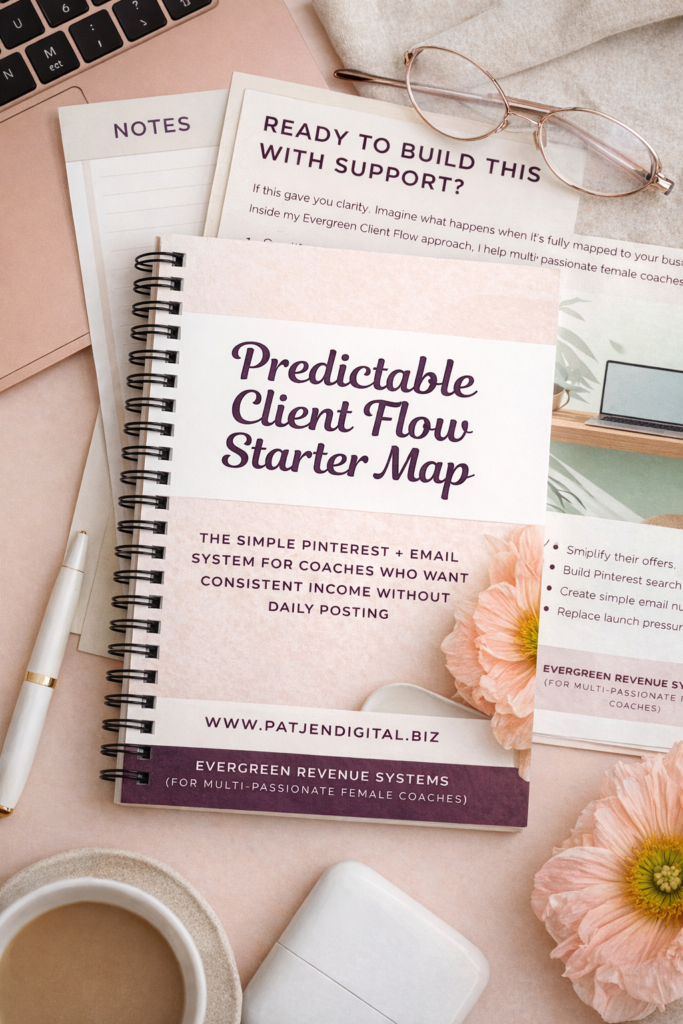
- Inside the Predictable Client Flow Starter Map, I walk you through the simple framework I use to help coaches move from inconsistent visibility to steady client flow using Pinterest and email.
- Download the guide and start building your client attraction system today.