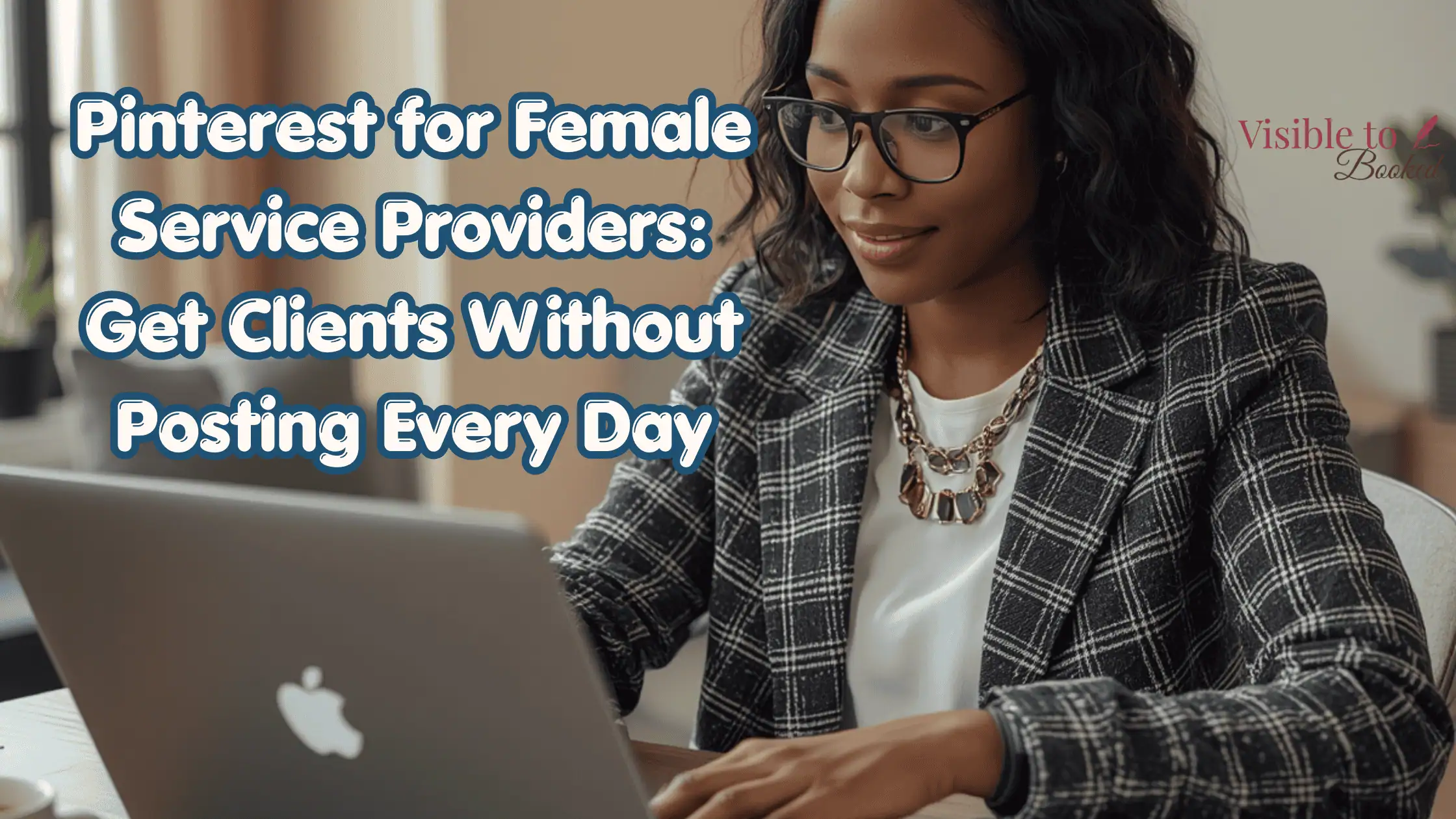
Pinterest for Female Service Providers: How to Get Clients Without Posting Every Day
Quick Answer
Pinterest works as a search engine, not a social media feed. For female service providers coaches, consultants, and copywriters it means your content keeps showing up in search results for months after you post it. You do not need to post every day. You need a properly set-up profile, keyword-rich pins that link to your offer or content, and a clear path from pin to enquiry.
Done right, Pinterest brings consistent, pre-qualified traffic to your business without the daily content grind.
If you are a coach, consultant, or copywriter who has spent the last year or two trying to figure out how to get consistent clients online, there is a good chance you have tried most of the obvious things.
Instagram posts have been published. Facebook groups have been worked. A few reels have probably been filmed, even if the camera does not feel comfortable. And every week, the same question comes back: why is this not converting into actual client calls?
Here is what most female service providers do not know about online marketing: the platforms built on daily content are designed to reward frequency. The algorithm needs you to keep posting so it keeps showing your content. The minute you step back, your reach drops. You are essentially renting visibility that disappears the moment you stop paying with your time.
Pinterest works differently. And that difference is worth understanding if you want clients coming to you without the daily grind.
In this post, I am going to walk you through how Pinterest for female service providers actually works, what a real strategy looks like, and how to know whether your current setup is even pointing in the right direction.
Why Pinterest Is Built for Service Providers

Pinterest is a search engine, not a social media platform. That is the distinction most people miss.
When someone opens Instagram, they are scrolling a feed of content from accounts they follow. When someone opens Pinterest, they are looking for something specific. They type in a question how to get more coaching clients, passive marketing strategy for consultants, Pinterest tips for service businesses and they land on content that answers it.
Your content on Pinterest does not expire. A pin you create today can surface in search results for months, sometimes years, after you post it. That is the opposite of Instagram, where a post has a shelf life of roughly 24 to 48 hours. For female service providers, this matters for two reasons.
First, you are running a business that requires your expertise, not your constant social media presence. Every hour you spend creating content that disappears in a day is an hour not spent on billable work or the strategic side of your business.
Second, your ideal clients are on Pinterest. Women searching for marketing strategies, business systems, and client attraction tools are active on the platform. Research consistently shows that Pinterest users skew toward women, are more likely to be in a buying mindset than on other platforms, and are actively searching for solutions not just scrolling for entertainment.
I noticed this years ago when I was building my own online presence. Most of the platforms I tried asked me to keep performing constantly just to stay visible. Pinterest was the first one that felt like it could actually work for me without requiring me to show up every single day.
Q: Is Pinterest actually worth it for a service-based business, or is it just for products?
A: Pinterest works very well for service-based businesses when the profile and pins are set up with strategy. The key is that you need something to send people to a blog post, a lead magnet, a discovery call page. Pinterest drives traffic. What that traffic finds when it arrives is what converts. If your website and offer are clear, Pinterest can become one of your most consistent lead sources.
What a Pinterest Strategy Actually Looks Like for a Service Provider
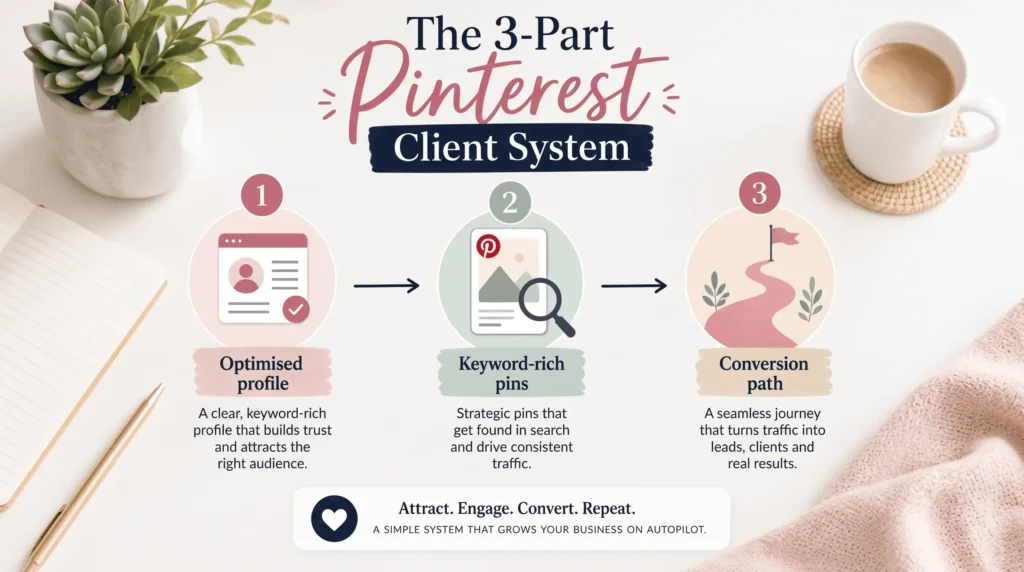
A Pinterest strategy for coaches and consultants does not require you to post every day, create short-form video, or build a following from scratch. Here is what it does require.
A properly optimised profile
Your bio, board names, and board descriptions all need to include the exact keywords your ideal clients are searching. Most Pinterest profiles for service providers are set up like a personal portfolio they describe what you do, not what your clients are looking for. That is the first gap.
A well-set-up profile tells the Pinterest algorithm who you serve and what topics you cover. Without that foundation, even the best pins will struggle to surface in the right searches.
Keyword-rich pins that link to useful content
Each pin should point to something valuable… a blog post, a lead magnet landing page, a services page. The pin title and description should use the same language your ideal client uses when they are searching for answers.
The phrase ‘Pinterest marketing for female coaches’ lands differently to a searcher than ‘my Pinterest strategy.’ One is what they are looking for. The other is what you call it.
Consistency without burnout
Most Pinterest experts recommend posting five to fifteen pins per week. But you do not need to create fifteen unique pieces of content. Repurposing one blog post into multiple pins… each with a different angle or image…is standard practice and effective. A focused batching session once or twice a month can cover your entire pinning schedule.
This is one of the things I help clients understand early on. The goal is not more content. The goal is the right content, pointed at the right keywords, linking to the right places.
A clear path from pin to conversion
Every pin you create should lead somewhere that moves a visitor closer to working with you. That might be a discovery call page, a lead magnet opt-in, or a blog post that positions your offer naturally. Traffic with no destination is wasted.
The full system looks like this: Pinterest brings in traffic, your content builds trust, and your offer or email list captures the lead. If any of those pieces are missing or disconnected, the strategy stalls.
If you want to understand how the full Pinterest-to-client system fits together, the Predictable Client Flow Starter Map walks you through the exact pieces: traffic, lead capture, and email nurture — all in one simple framework. It is free.
The Honest Conversation About Timeline
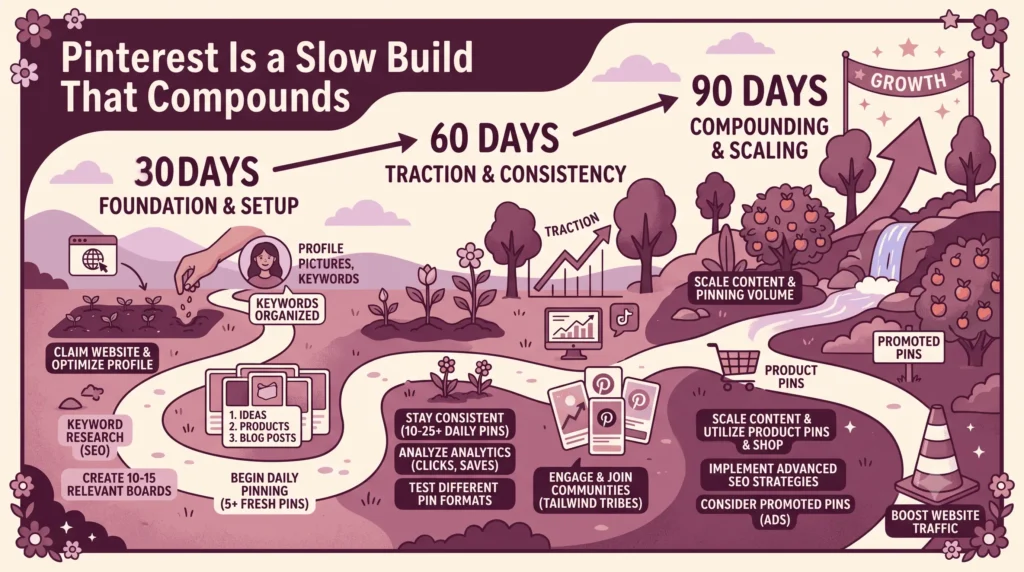
Pinterest is not a quick fix. Content that is indexed well and linked to a keyword-rich profile can take 60 to 90 days to build momentum. This is a platform that rewards patience and consistency…not urgency.
But the thing about building on Pinterest is that your content compounds. A pin you created in month two is still working in month six. That is not how any other platform operates.
Female service providers who commit to a Pinterest strategy for 90 days consistently report that organic traffic to their website increases, discovery calls come from people who already understand what they do, and the quality of inbound leads is higher because the prospect searched for a solution before finding them. The platform does some of the qualifying for you.
I have seen this in my own work and in the accounts I have set up for clients. The first few weeks can feel quiet. Then the search impressions start to grow. Then the clicks follow. The pattern is predictable once the foundation is right.
Q: How long does it take to see results from Pinterest as a service provider?
A: Most Pinterest accounts for service providers start to see meaningful search impressions within 30 to 45 days of consistent posting to an optimised profile. Clicks and traffic to your website typically begin building between 60 and 90 days. Leads and enquiries follow after that, once visitors have had time to read your content and understand your offer. Pinterest is a slow build that compounds…not an overnight result.
What I Have Learned After Setting Up Pinterest for Service Providers
My background is in banking, operations, and running a print shop for years before I moved online. When I discovered Pinterest, specifically through Jenna Kutcher’s course, it made sense to me immediately. Content that gets found over time. Not content you have to keep pushing every day just to stay visible.
That logic transferred directly to what I now help clients build. The women I work with are coaches, consultants, and service providers who are already good at what they do. What they do not have time for is creating content that disappears every 24 hours.
The accounts that perform best share three things: a clear offer, a well-set-up profile with the right keywords, and a lead magnet or content library that gives visitors a reason to click through. When all three are in place, Pinterest becomes one of the quietest but most consistent parts of a marketing system.
The accounts that struggle usually have at least one of those three things missing. The profile is set up like a portfolio. The pins link to a homepage instead of a specific offer. Or there is nothing to capture the visitor once they arrive.
Getting those gaps identified and fixed is usually where I start with new clients.
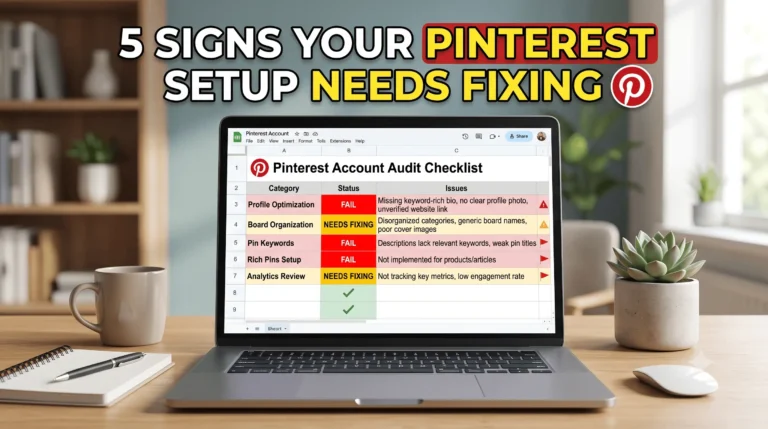
How to Know Whether Your Pinterest Profile Is Actually Working
Most service providers who come to me have a Pinterest account. The profile exists. There are boards. There might even be a few pins. But the account is not bringing in any traffic, and they are not sure why.
The most common gaps I find are these.
- The profile bio uses the business name but not the keywords ideal clients actually search.
- Board names are descriptive but not keyword-rich ‘My Business Tips’ instead of ‘Marketing Tips for Women Coaches.’
- Pins link to a homepage instead of a specific blog post, lead magnet, or landing page.
- There is no lead capture in place, someone clicks through and arrives at content with no next step.
- Posting is inconsistent or stopped after a few weeks because results were not immediate.
Any one of those gaps can stall a Pinterest strategy. Two or three of them together means the account is essentially invisible, no matter how many pins are posted.
A quick audit of your current profile can show exactly which of these gaps apply to your account and what to fix first.
Q: What is the biggest mistake female service providers make with Pinterest?
A: The most common mistake is treating Pinterest like a social media platform and focusing on follower counts or engagement. Pinterest is a search engine. The metrics that matter are impressions (how often your content appears in search), outbound clicks (how many people click through to your website), and saves (how often people bookmark your pins to share later). Setting up boards and pins around what clients are searching for not around what feels interesting to post is the foundation everything else builds on.
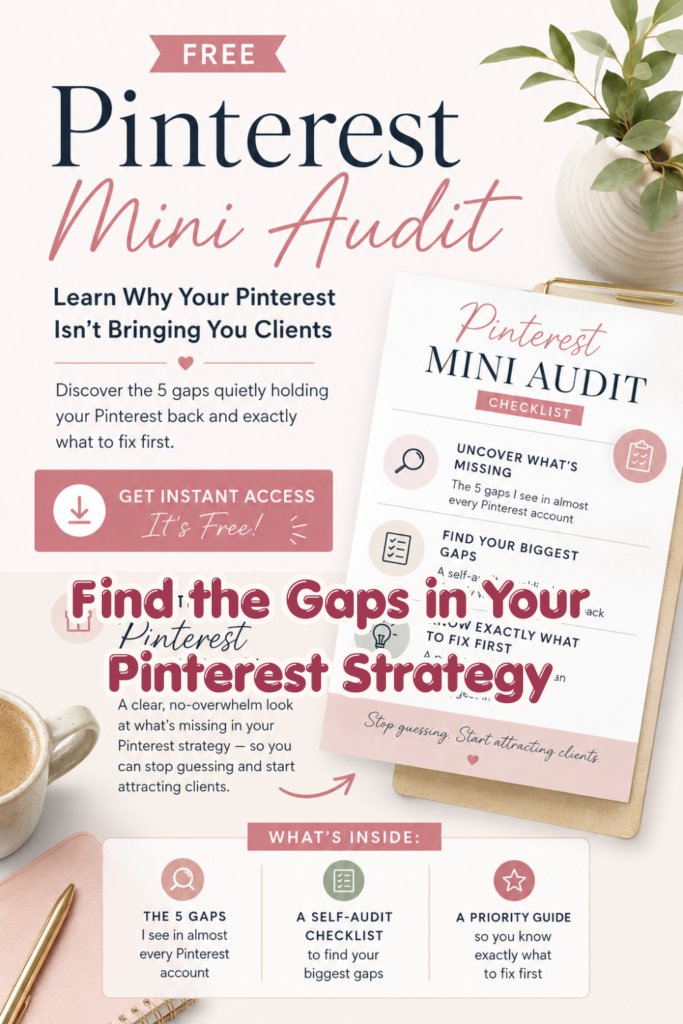
Not Sure Whether Your Pinterest Profile Is Set Up to Attract Clients?
If you have a Pinterest account but it is not bringing consistent traffic to your website, the issue is usually in the setup not the effort you are putting in.
The Free Pinterest Mini Audit Checklist gives you a clear picture of what is working and what is not. It walks you through the exact areas I check when I review a new client account: profile setup, board strategy, keyword use, pin structure, and conversion path.
It takes about 15 minutes to complete and will show you exactly where to focus first.
Get the Free Pinterest Mini Audit Checklist →
And if you would like to understand the full system that connects Pinterest traffic to leads and clients, the Predictable Client Flow Starter Map is the place to start.
Get the Predictable Client Flow Starter Map →
Frequently Asked Questions
Key Takeaways
- Pinterest is a search engine, not a social platform your pins do not expire the way Instagram posts do.
- Female service providers are well-positioned for Pinterest because their ideal clients are actively searching for solutions on the platform.
- A working Pinterest strategy requires three things: an optimised profile, keyword-rich pins, and a clear conversion path.
- Pinterest traffic takes 60–90 days to build but compounds over time a pin created in month two keeps working in month six.
- You do not need to create new content every day. One blog post or lead magnet can become multiple pins with different angles.
Hi I’m Patricia Jennings
A Pinterest strategist and digital marketer. After decades building and managing businesses I have moved online in search of work that fit around my family and my life. Through Visible to Booked, I help female coaches, consultants, and service providers build a steady Pinterest presence that brings in consistent visibility, traffic, and leads without the pressure of daily social media posting.

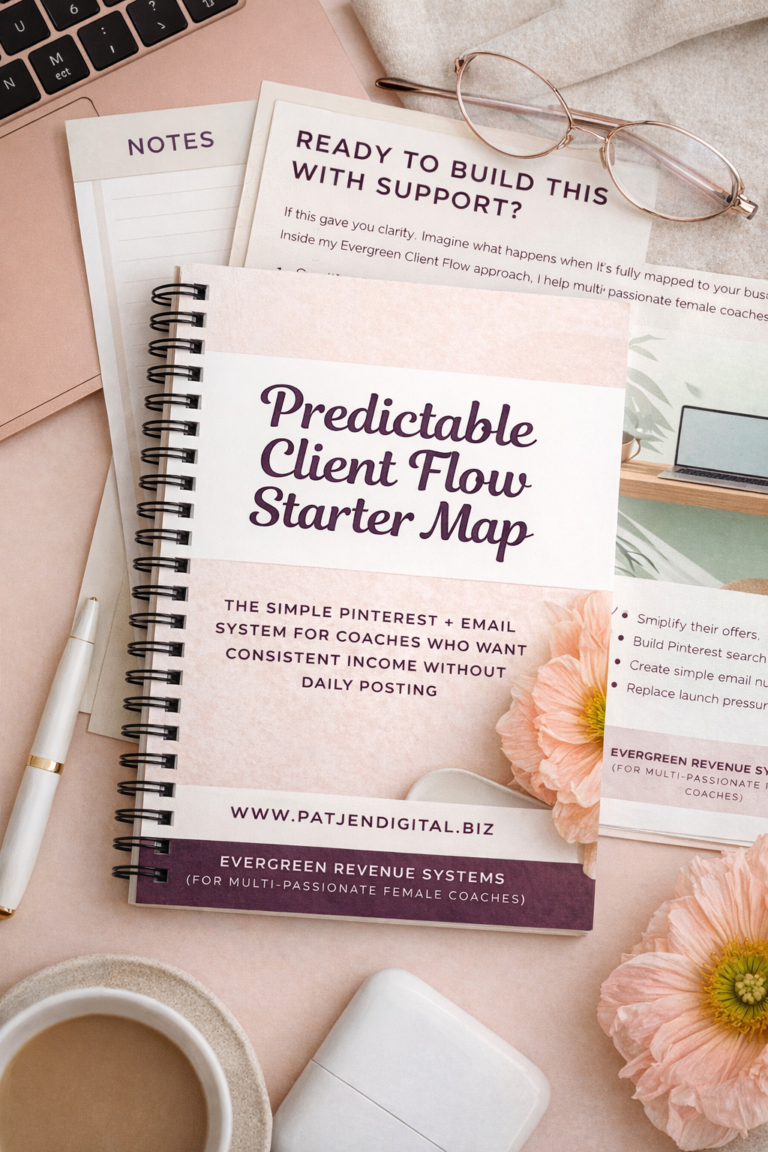
Get the Predictable Client Flow Starter Map!
- When you have a clear system for visibility, nurturing, and client attraction, sales stop feeling random and start feeling predictable.
- Inside, you will learn the simple framework I use to help coaches move from revenue spikes to steady, structured client flow using Pinterest and email.


One Comment